English
What are you looking for?

"According to the latest market research from Bozhan Consulting, thermal conductive adhesive is the fastest-growing segment of electronic adhesives, with China's market size expected to exceed RMB 11 billion in 2026 and a compound annual growth rate of 28.5% from 2024 to 2026."
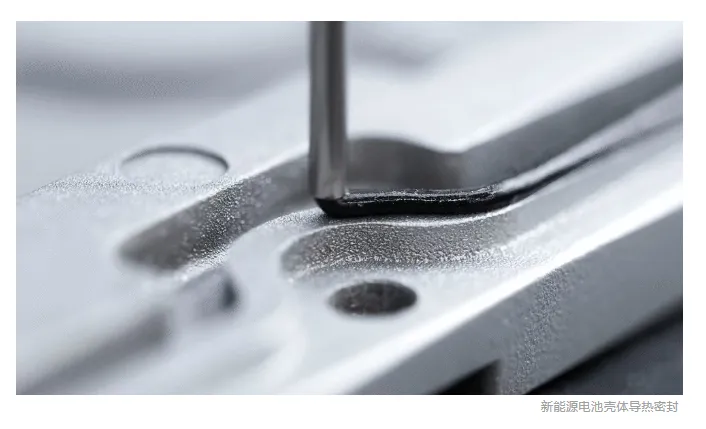
From NEV motor sealing to power battery thermal management and heat dissipation of high-performance electronic components, thermal conductive adhesive — with its excellent bonding, insulation and conductivity — is becoming an indispensable material in modern manufacturing.
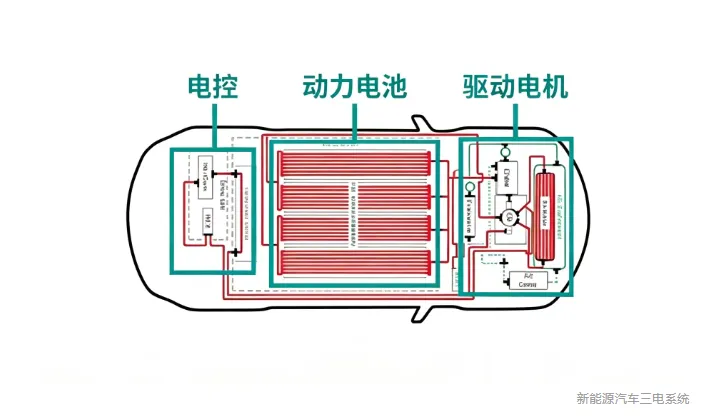
Especially in the core components of the NEV three-electric system (battery, motor, electronic control), thermal conductive adhesive plays multiple roles in structural bonding, heat transfer and performance protection.
The essence of thermal conductive adhesive is to combine high-thermal-conductivity fillers with a polymer matrix to achieve the combined functions of "thermal conductivity + fixation + sealing." These fillers typically have high hardness, and improved thermal conductivity usually comes with a higher filler ratio — which brings new challenges to the coating process:
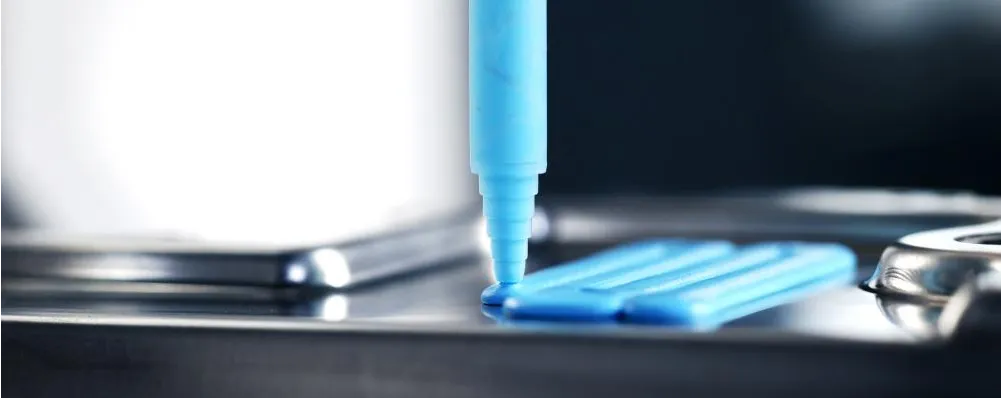
High filler content raises viscosity and reduces fluidity. Thermal conductive adhesive viscosity often ranges from several million to over ten million cps, causing problems such as insufficient supply pressure, discontinuous dispensing and noticeable volume fluctuation.
Thermal conductive adhesive contains a large amount of hard, irregular fillers (aluminum oxide, silicon carbide, etc.). Flowing through the equipment pipeline, these fillers are tantamount to "sandpaper" grinding the metal inner wall, leading to risks such as reduced precision, dripping and rising maintenance costs.
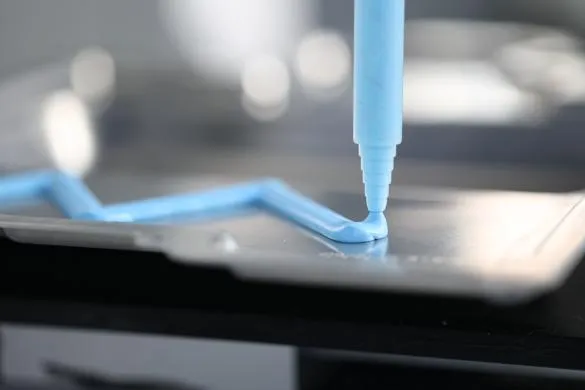
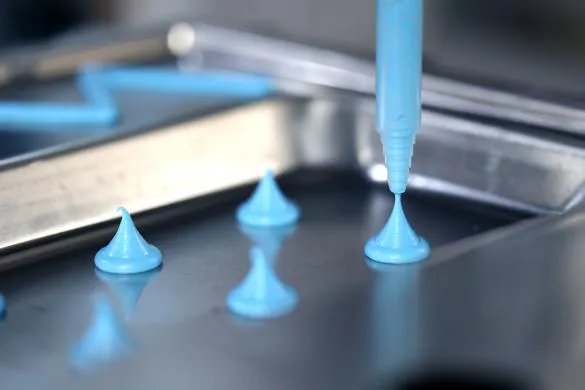
In continuous production scenarios such as automotive electronics, the equipment must not only "dispense" but also ensure stable delivery during long-term operation. Any deviation in volume or bead shape causes uneven heat dissipation or glue overflow.
Two-component thermal conductive adhesive requires not only precise metering but also a stable A/B mixing ratio. Ratio deviation affects adhesive curing and thermal conductivity, further impacting product reliability.
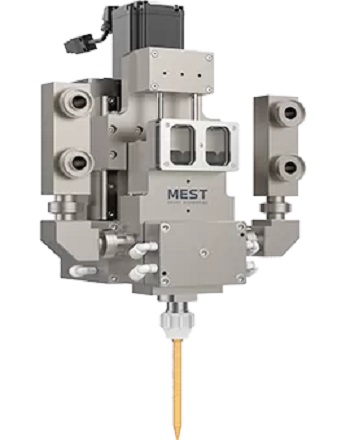
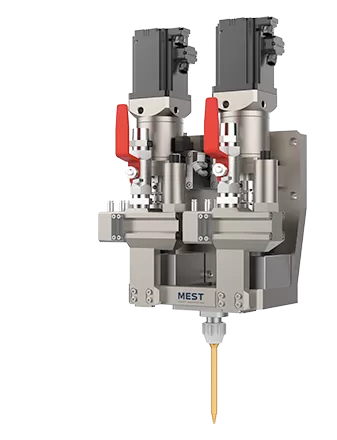
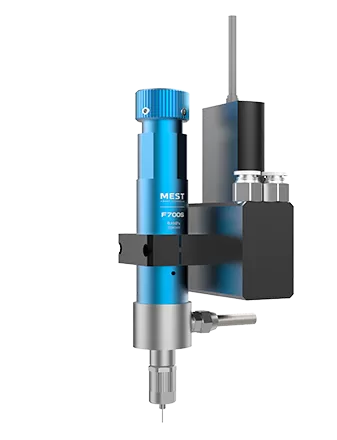
Facing the ever-higher process requirements in new energy and high-end manufacturing, MEST — drawing on in-depth research in precision fluid control technology — launches the Piston Metering Valve MEST-P600.
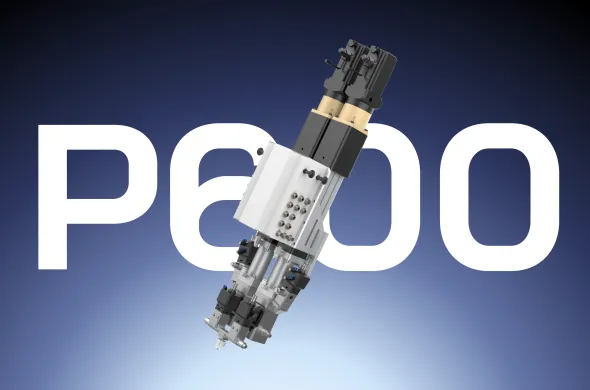
MEST-P600 offers higher viscosity adaptability, handling highly abrasive adhesives with a maximum viscosity of up to 1,000,000 cps. Meanwhile, full-process inlet/outlet pressure monitoring ensures continuous, smooth supply of high-viscosity adhesive for stable dispensing.
MEST-P600 adopts a hard, corrosion-resistant ceramic piston; the cylinder body and flow channel use wear-resistant materials with an optimized design to reduce inner-wall wear. Its modular component design with removable parts lowers maintenance costs.
MEST-P600 uses volumetric piston metering, with controlled metered volume in the 8–160 ml range; excellent self-priming and suck-back functions effectively avoid dripping and stringing, achieving repeat accuracy of <2%.
For the mixing ratio requirements of two-component thermal conductive adhesive, MEST-P600 supports a volume mixing ratio of 1:1–5:1; with no hardware reconfiguration, simply operating the control software changes the ratio and flow rate to meet high-performance adhesive coating needs.
As a precision metering valve designed specifically for high-viscosity, high-filler thermal conductive adhesive, the detailed configuration parameters of MEST-P600 are as follows:
.webp "Piston Metering Valve MEST-P600.png")
Facing the coating challenges of high-viscosity, high-filler thermal conductive adhesive, MEST-P600 — with precise metering, stable output and a wear-resistant, reliable design — delivers an efficient, stable dispensing solution for new energy, high-power electronics and other fields.

If you are looking for a dispensing solution suited to thermal conductive adhesive applications, welcome to send us a private message or call 400-100-1011 for dedicated process support!

Industry professional with deep expertise in dispensing manufacturing technology. Focused on precision fluid control, automation solutions, and process optimization for adhesive, sealant, and coating applications. Leverages practical knowledge of dispensing systems, fluid dynamics, and material science to analyze manufacturing challenges and contribute to efficient, reliable production processes. Experienced in collaborating with cross-functional teams to ensure clarity and precision in technical communication and implementation.