English
What are you looking for?

The terms metering valve and metering pump are often used together in fluid-dispensing systems, but they do not always perform the same function.
A production engineer choosing equipment for adhesives, sealants, thermal materials, potting compounds, or two-component fluids may need to control both the amount of material delivered and the moment when that material starts or stops flowing.
In many systems, this means the decision is not simply “valve or pump.” The pump and valve may work together as different parts of the same metering architecture.
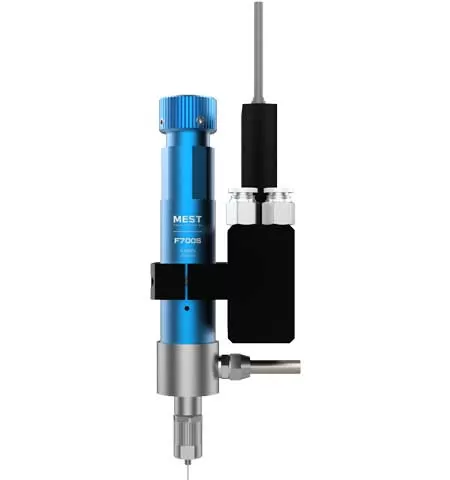
A metering valve primarily controls the fluid path and dispense event at or near the dispensing point. Depending on its design, it can regulate flow, start and stop dispensing, and help define the final deposit. Some valve mechanisms can also contribute to dose control; the exact role depends on the system architecture.
A metering pump actively moves a defined quantity or flow of material through the system. Different pump mechanisms—such as piston, plunger, or gear designs—can produce different dispensing characteristics.
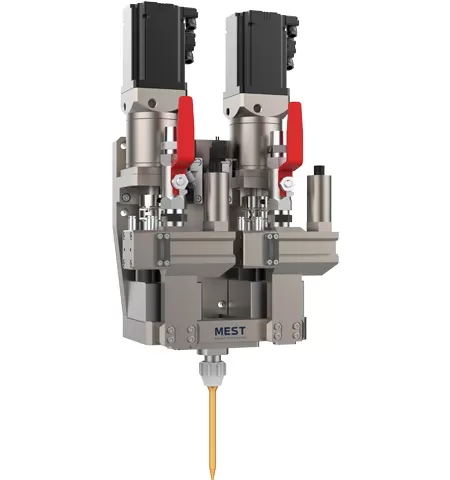
MEST groups these technologies within its metering valve and metering pump range and currently offers plunger, piston, and precision gear metering solutions.
This distinction becomes especially important when the application requires precise volumetric control rather than simple open/close fluid control.
| Factor | Metering Valve | Metering Pump |
|---|---|---|
| Main role | Controls the dispense event, outlet behavior, or flow path | Moves material and meters displacement or flow |
| Output control | May regulate flow or dose depending on valve mechanism, pressure, time, and control settings | Based more directly on pump displacement, geometry, or rotation |
| Start/stop control | Strong at the dispensing outlet | Can control a dosing cycle; an inlet/outlet or separate dispense valve may be integrated when clean shutoff is required |
| Intermittent dosing | Suitable depending on system and outlet requirement | Piston/plunger solutions are common |
| Continuous dispensing | Possible as part of system | Gear pumps are especially relevant |
| 1K/2K applications | Depends on system design | Dedicated metering architectures available |
| High viscosity | Valve- and material-dependent | Pump mechanism can be selected according to viscosity, fillers, and abrasiveness |
| Mixing ratio control | Usually not valve alone | Pump displacement can support ratio control; validate the actual ratio at the mixer outlet |
One of the most useful selection questions is whether the process requires discrete doses or a continuous bead.
Piston and plunger metering technologies are particularly useful when a defined chamber volume can be filled and discharged repeatedly.
MEST's P20 piston metering pump, for example, uses an intermittent dispensing method and is designed for both 1C and 2C materials. Its specifications include a minimum dispensing quantity of 0.01 ml, maximum dispensing quantity of 35 ml, and a stated viscosity range of 100–2,000,000 cps.
Gear metering is different.
The rotating gears continuously transport material from inlet to outlet. The amount delivered is related to gear geometry and rotational speed. This makes gear technology particularly useful when a continuous bead or controlled continuous flow is required.
MEST's Gear Metering Pump GP30 uses gear quantification and continuous discharge. The model is specified for viscosities from 100 to 300,000 cps, minimum output of 0.01 ml, and both single- and two-component configurations. Its product specification also identifies the GP30 for non-abrasive materials; confirm how “minimum output” is defined for the intended continuous process.
Therefore, the practical difference can often be summarized as:· defined intermittent shot → consider piston/plunger metering· controlled continuous bead → consider gear metering, especially for non-abrasive materials within the specified rangeThe final choice still depends on material properties and process requirements.
A piston pump can be attractive when the application requires repeatable individual shots.
MEST's Piston Metering Pump P20 is specified for intermittent dispensing, with a volume flow range of 0.3–10 ml/s and minimum output of 0.01 ml. It also supports specified volumetric mixing ratios from 100:100 to 100:7.
This type of architecture can be useful for applications such as controlled filling, potting, bonding, or other processes where each cycle requires a defined amount.
The P20's broad stated viscosity range also makes it relevant when the material is too viscous for systems that depend heavily on simple pressure-time control.
Gear pumps are particularly useful for continuous output.
As the gears rotate, material is transported through the pump and discharged continuously. Adjusting rotational speed changes the delivered flow, making the technology useful for processes such as continuous adhesive beads and sealant application.
MEST's Gear Metering Pump GP30 uses gear quantification and continuous discharge. The model is specified for viscosities from 100 to 300,000 cps, minimum output of 0.01 ml, and both single- and two-component configurations.
Therefore, the practical difference can often be summarized as:
defined intermittent shot → consider piston/plunger metering
controlled continuous bead → consider gear metering
The final choice still depends on material properties and process requirements.
Viscosity changes the pressure required to move material and can affect filling, flow stability, pressure loss, and response at the dispensing outlet.
But viscosity alone is not enough.
Engineers should also consider whether the adhesive contains fillers or abrasive particles, whether viscosity changes with temperature or shear, and whether the material cures when exposed to air or moisture.
The P20 and GP30 demonstrate why pump architecture matters. MEST lists the P20 for materials up to 2,000,000 cps, whereas the GP30 has a stated range up to 300,000 cps. These specifications do not mean one pump is universally better; they indicate that each mechanism is intended for a different operating envelope. In particular, the GP30 specification should not be treated as a default recommendation for abrasive-filled materials.
Two-component materials add another requirement: maintaining the correct mixing ratio.
If component A and component B are delivered inconsistently, the final adhesive can have incorrect curing behavior even when the total dispensed volume appears acceptable.
This makes volumetric metering particularly important.
The P20 is designed for both single- and two-component materials, while the GP30 is also available in 1C and 2C configurations. Their different metering principles provide options for intermittent and continuous two-component processes.
For a 2K application, buyers should therefore evaluate:
mixing ratio range, ratio repeatability, minimum output, material viscosity, filler content, pot life, flushing requirements, and whether the process is continuous or intermittent.
Plunger technology provides another positive-displacement option.
It is generally considered alongside piston and gear technologies when an application requires controlled volumetric material delivery. The exact choice depends on material characteristics, output volume, repeatability, duty cycle, and the mechanical design of the metering system.
MEST includes the Plunger Metering Pump MP50 alongside its piston and gear solutions in the metering product family.
Rather than selecting between pump types by name alone, procurement teams should provide actual process data to the equipment supplier.
A useful RFQ should include more than “we need a precision metering pump.”
Provide:
material name and technical data sheet;
viscosity and operating temperature;
1K or 2K configuration;
required mixing ratio;
minimum and maximum dispense quantity;
continuous or intermittent dispensing;
required cycle time;
desired bead or dot geometry;
filler or abrasive content;
material supply pressure;
required repeatability;
cleaning and maintenance requirements;
available PLC/control interface.
MEST also recommends considering medium compatibility, flow requirements, pressure level, repeatability, control signals, and maintenance conditions when selecting metering equipment.
The metering valve vs metering pump question does not always have an either-or answer.
A valve primarily manages material discharge and shutoff, while a metering pump provides controlled material movement and volumetric delivery. In many precision dispensing systems, they work together.
For intermittent volumetric dispensing, piston or plunger systems can be strong candidates. For controlled continuous output, gear metering can provide a more suitable architecture. When two-component materials are involved, mixing-ratio control becomes an additional selection priority.
The right choice should therefore be based on dispensing mode, viscosity, required volume, mixing ratio, pressure, production speed, and maintenance requirements—not on the equipment name alone. It should also account for material abrasiveness, outlet shutoff requirements, and process validation at the required production conditions.
Is a metering valve the same as a metering pump?
No. A valve generally regulates or shuts off the flow path, while a pump actively moves and meters material. They can be used together in one dispensing system.
Which metering pump is best for high-viscosity adhesive?
There is no universal answer. Pump mechanism, viscosity range, filler content, required output, and dispensing mode should be considered together.
Is a gear metering pump suitable for continuous dispensing?
Yes. MEST's GP30 uses continuous gear discharge and is intended for controlled continuous material delivery.
Which metering technology is better for two-component adhesives?
The system should accurately meter both components according to the required ratio. Piston, plunger, or gear systems can be considered depending on whether the process is intermittent or continuous and on the material properties.

Industry professional with deep expertise in dispensing manufacturing technology. Focused on precision fluid control, automation solutions, and process optimization for adhesive, sealant, and coating applications. Leverages practical knowledge of dispensing systems, fluid dynamics, and material science to analyze manufacturing challenges and contribute to efficient, reliable production processes. Experienced in collaborating with cross-functional teams to ensure clarity and precision in technical communication and implementation.