English
What are you looking for?

Precision adhesive dispensing is not simply a matter of pushing fluid through a small opening. When manufacturers need repeatable dots, short beads, or micro-volume deposits, the way a valve starts and stops material flow can directly affect dot size, edge quality, stringing, dripping, and cycle consistency.
A needle dispensing valve is commonly used for this type of controlled adhesive application. Instead of relying only on changes in material pressure, it uses a mechanically controlled needle to open and close the fluid path. This makes the valve especially useful when manufacturers need clearly defined start-stop control in automated dispensing processes.
However, selecting a needle valve requires more than checking whether the adhesive can pass through it. Fluid viscosity, required deposit size, dispensing frequency, feed pressure, needle diameter, shutoff behavior, and production speed should all be considered together.
A typical pneumatic needle dispensing valve uses a piston, spring, and needle mechanism. Pneumatic actuation moves the needle away from the valve seat to open the fluid passage. When the actuation signal stops, the needle returns and closes the passage, cutting off material flow.
This simple operating principle gives the valve an important advantage in automated dispensing: the start and stop of each deposit can be controlled independently from the fluid supply.
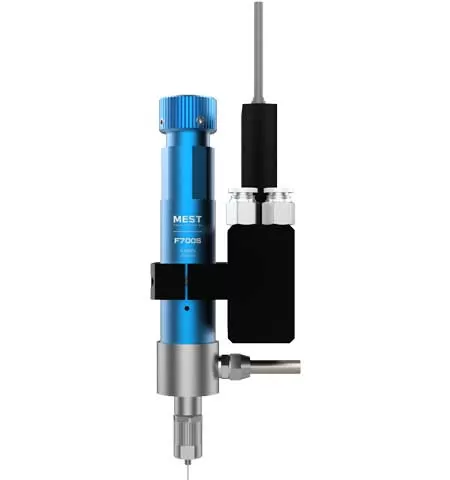
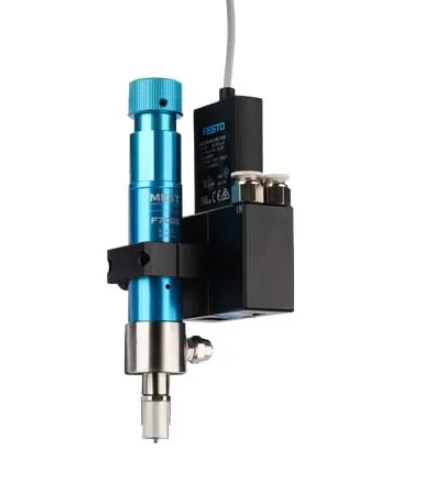
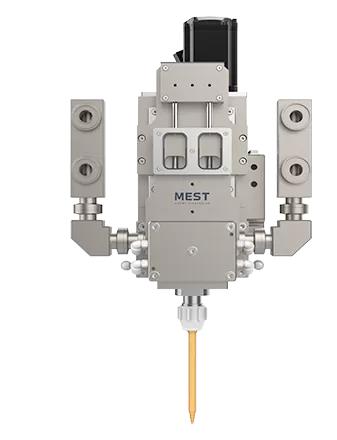
For example, the MEST Needle Dispensing Valve F700 is designed for automated micro-volume dispensing. Its needle stroke can be adjusted, and different dispensing needles can be selected according to the required application. MEST specifies a compatible viscosity range of 0–20,000 cps for both F700 and F700S versions.
The end of the dispensing cycle is often just as important as the beginning.
When the valve closes, residual pressure may continue forcing adhesive through the needle. Depending on material rheology and system pressure, this can cause:
dripping after the valve closes;
stringing between the needle and workpiece;
oversized dots;
tails at the end of a bead;
material accumulation around the needle tip.
For this reason, buyers should evaluate not only maximum flow but also shutoff response and, where required, suck-back behavior.
A fast, clean mechanical shutoff is particularly valuable for short-cycle applications. MEST describes the F700 as having a zero-residue shutoff design intended to provide a cleaner adhesive cutoff during dispensing.
In practice, poor cutoff is not always caused by the valve itself. Excessive feed pressure, an unsuitable needle diameter, material temperature changes, or a dispense delay that is too long can produce similar symptoms.
Viscosity strongly affects how easily adhesive moves through the fluid path and needle.
Low-viscosity liquids generally flow quickly and can continue dripping if the system pressure is too high. More viscous materials require greater pressure and a sufficiently large flow path. Extremely high-viscosity adhesives may be better handled by screw or other positive-displacement technologies rather than a conventional needle valve.
MEST specifies the F700 for materials including epoxy resin, UV adhesive, silicone gel, conductive adhesive or silver paste, ink, grease, and similar industrial fluids, with a stated viscosity range up to 20,000 cps.
If a project involves a wider range of materials, the broader MEST dispensing valve portfolio includes needle, screw, piezoelectric, jetting, and metering solutions intended for different dispensing volumes and material behaviors.
The important question is therefore not simply:
“Can this valve dispense my adhesive?”
A better question is:
“Can it dispense the required volume repeatedly at my target cycle time without unacceptable dripping, stringing, pressure fluctuation, or material waste?”
Needle selection changes fluid resistance at the final outlet.
A smaller needle can help create smaller deposits, but it also increases resistance. For a relatively viscous adhesive, an excessively small needle may require higher feed pressure, slow the dispensing cycle, or make dot volume less stable.
A larger needle reduces resistance but may make very small deposits harder to control.
The F700 supports needle specifications from 13G to 30G, providing a relatively wide range for adapting the outlet to different dispensing requirements. It also provides firing-pin specifications of 2.0, 3.0, and 4.0 mm.
Rather than selecting the smallest available needle automatically, engineers should test the combination of:
needle size + adhesive viscosity + feed pressure + valve-open time + required deposit volume.
This combination usually provides a more useful basis for process development than needle diameter alone.
Production speed becomes critical when thousands of dots must be applied during every shift.
A valve that produces a good deposit in a laboratory test may still become a bottleneck if its actuation frequency cannot match the required machine cycle.
MEST lists a maximum dotting frequency of up to 100 Hz for the F700 system under its specified control configuration. The product also uses a tungsten-steel firing pin and SUS304 runner components.
High frequency, however, should not be evaluated independently. Increasing dispensing speed while maintaining the same adhesive viscosity, pressure, and needle diameter may change the actual deposit behavior.
Production trials should therefore evaluate both:
dispensing speed and deposit consistency.
Stringing commonly appears when a viscous or elastic adhesive remains connected between the needle and substrate after dispensing.
Check material temperature, needle-to-workpiece distance, shutoff timing, needle diameter, and movement speed before simply increasing pressure.
Dripping after shutoff may indicate excessive material pressure, insufficient cutoff control, low fluid viscosity, or an unsuitable valve configuration.
Reducing pressure without considering the required output can create a different problem: incomplete or inconsistent dots.
Variation can come from trapped air, fluctuating feed pressure, material viscosity changes, inconsistent valve timing, or changing needle conditions.
For automated production, troubleshooting should therefore include the entire dispensing head and material delivery system rather than focusing only on the needle tip.
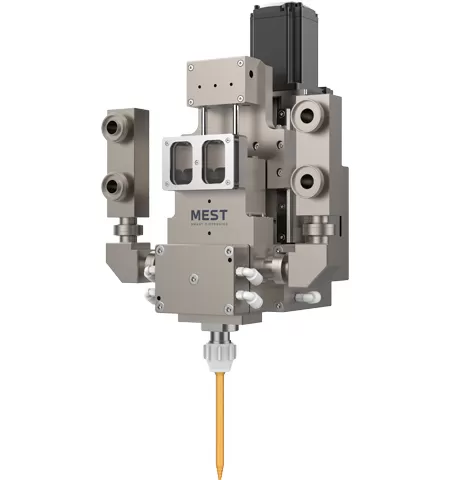
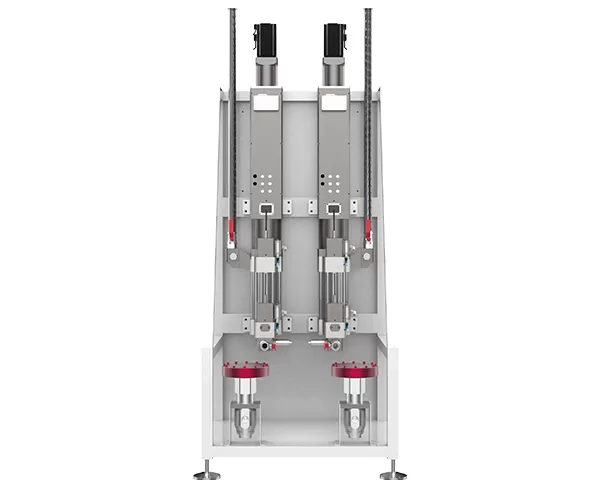
MEST's dispensing-head portfolio covers several valve technologies intended for adhesives, sealants, lubricants, and specialty coatings.
Material accumulated at the outlet can gradually change the effective dispensing geometry. Cleaning intervals should therefore be determined according to adhesive curing behavior and actual production conditions rather than using one fixed schedule for every material.
A needle valve is particularly useful when the process requires controlled contact dispensing, small deposits, clear start-stop behavior, and relatively straightforward integration into automated equipment.
Typical processes can include electronics assembly, component bonding, medical-device manufacturing, LED processes, adhesive coating, and other precision fluid applications. MEST specifically positions the F700 for micro-volume industrial dispensing and automated production integration.
However, a needle valve is not automatically the best solution for every adhesive.
Very high-speed non-contact dispensing may favor jetting technology. Extremely viscous or filled materials may require screw dispensing. Two-component applications may require a dedicated metering and mixing system.
The best valve is therefore the one that matches the fluid, dispensing pattern, required volume, cycle time, and automation architecture as a complete system.
Choosing a needle dispensing valve should begin with the actual dispensing process rather than with valve size alone. Adhesive viscosity, deposit volume, needle specification, pressure, shutoff quality, dispensing frequency, and automation requirements all influence final performance.
For micro-volume applications, MEST's F700 provides adjustable stroke, multiple needle options, compatibility with fluids up to 20,000 cps, and automated high-frequency operation. These specifications provide a useful starting point, but actual adhesive testing remains important because material rheology and production conditions can significantly affect dispensing results.
What fluids can a needle dispensing valve handle?
Needle valves can be used with many industrial adhesives and fluids, but compatibility depends on viscosity, abrasiveness, curing behavior, pressure, and wetted materials.
Does a smaller needle always produce better precision?
No. A smaller needle increases flow resistance. The correct size should balance required deposit volume with viscosity, pressure, and cycle time.
Why does adhesive continue dripping after the valve closes?
Possible causes include residual fluid pressure, low viscosity, unsuitable shutoff settings, an oversized outlet, or poor pressure control.
When should a screw valve be used instead of a needle valve?
A screw valve may be more suitable when the material is highly viscous or when positive-displacement control provides better repeatability for the required process.

Industry professional with deep expertise in dispensing manufacturing technology. Focused on precision fluid control, automation solutions, and process optimization for adhesive, sealant, and coating applications. Leverages practical knowledge of dispensing systems, fluid dynamics, and material science to analyze manufacturing challenges and contribute to efficient, reliable production processes. Experienced in collaborating with cross-functional teams to ensure clarity and precision in technical communication and implementation.