English
What are you looking for?

Automating adhesive dispensing does not always require the same machine architecture. A manufacturer assembling several product variants in batches may have very different requirements from a factory operating a continuous conveyor line with a fixed takt time.
This is why the choice between a desktop dispensing robot and an inline dispensing robot should not be reduced to which machine is “more automated.”
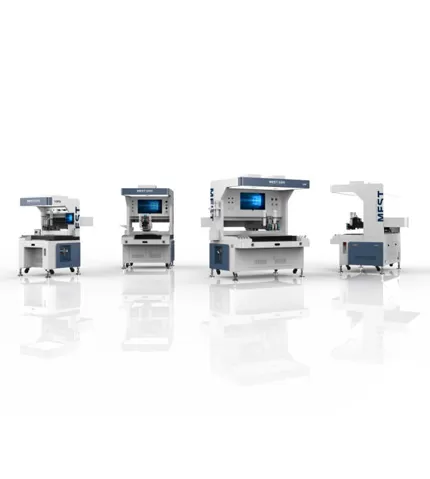
Both can automate dispensing paths and improve process repeatability. The real difference lies in how workpieces enter the machine, how production is organized around it, how quickly products change, and how closely the dispensing process must be connected to upstream and downstream equipment. MEST currently offers desktop, panoramic, inline, and dispensing-station configurations within its dispensing robot portfolio.
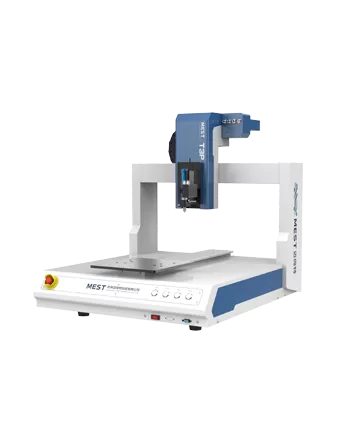
A desktop or benchtop dispensing robot normally operates as an individual workstation. The workpiece is loaded into a fixture, the dispensing program runs, and the finished part is removed before the next cycle.
An inline dispensing robot is designed to become part of a larger automated production flow. Parts can be transferred between stations through conveyor-based or other automated handling systems, reducing dependence on manual loading between production processes. MEST positions its desktop systems for compact, flexible dispensing and its inline systems for production-line operation.
| Selection Factor | Desktop Dispensing Robot | Inline Dispensing Robot |
|---|---|---|
| Production layout | Independent workstation | Integrated production line |
| Workpiece loading | Commonly manual/semi-automatic | Usually automated |
| Footprint | Relatively compact | Requires line space |
| Product changeover | Well suited to frequent changes | Better for stable processes |
| Production volume | Low to medium / batch production | Medium to high / continuous production |
| Conveyor integration | Not always required | Usually important |
| Initial system complexity | Lower | Higher |
| Expansion | Add individual stations | Integrate with wider automation |
Floor space is one of the most practical selection factors.
A desktop dispensing robot concentrates motion control and dispensing in a compact workstation. MEST's desktop systems use Cartesian motion and can support X-, Y-, and Z-axis movement, with selected configurations incorporating vision and height-sensing functions.
This architecture can be useful when a factory wants to automate an existing manual station without rebuilding the whole line.
Inline equipment requires more planning. Engineers must consider conveyors, buffers, safety guarding, material supply, upstream/downstream stations, maintenance access, and the overall direction of product flow.
Therefore, a smaller machine is not automatically “less advanced.” A desktop system may simply match the factory layout better.
One of the clearest differences appears in workpiece handling.
For batch production, an operator can load a jig containing one or several components into a desktop machine. This approach can remain efficient when production quantities are moderate or when product variants change frequently.
Inline equipment becomes more attractive when stopping the production flow for manual loading would create a bottleneck.
MEST describes its inline dispensing robots as systems designed to keep pace with modern production lines, with dispensing speed adjusted according to material characteristics and application requirements.
This makes the inline architecture particularly relevant when dispensing is only one step among several automated operations.
Buyers often compare only maximum movement speed.
That can be misleading.
Actual production takt time may include:
workpiece loading → positioning → recognition → dispensing → curing or inspection → unloading.
A desktop robot may move very quickly but still require an operator to exchange fixtures. Conversely, an inline system may have a more complex cycle but eliminate manual transfer between machines.
The correct comparison is therefore finished parts per hour under the complete production process, not simply axis speed.
MEST notes that inline dispensing speed depends on dispensing complexity, material type, and application requirements, which is why production trials should reproduce the actual material and pattern rather than using an unloaded motion test.
Product variation is another important decision factor.
When fixtures, component positions, or product models frequently change, vision-assisted positioning can reduce the need for highly rigid mechanical locating.
MEST's desktop product information describes systems using CCD fiducial recognition and laser height sensing to compensate for changes in product position and surface height.
This can make desktop equipment attractive for manufacturers handling:
multiple SKUs;
prototype and pilot production;
relatively short production runs;
components with position variation;
frequent process development.
Inline systems can also incorporate vision, but the business case is usually strongest when the line runs sufficient volume to justify deeper automation.
A major reason to choose inline equipment is integration.
A continuous production line may need the dispensing station to communicate with PLCs, conveyors, sensors, inspection equipment, curing equipment, or manufacturing execution systems.
An inline architecture makes it easier to build a sequence such as:
product arrives → identification → positioning → dispensing → inspection → automatic transfer.
By contrast, a desktop robot can remain more independent from the rest of the factory.
MEST's wider dispensing robots range includes desktop, panoramic, inline, and station-type systems, allowing the equipment architecture to be selected according to the automation level of the overall process rather than treating one robot type as suitable for every application.
A desktop machine will generally require less surrounding automation than an inline production cell.
But purchase price alone does not determine total cost.
An inline system may justify a higher investment when it reduces repeated loading labor, eliminates workpiece transfers, prevents line bottlenecks, or allows a process to operate continuously.
A desktop system may provide a better return when production volume does not justify conveyor integration or when frequent SKU changes would leave a dedicated inline system underutilized.
Buyers should therefore compare:
equipment investment + fixtures + integration + operators + changeover time + maintenance + expected annual production volume.
Choose a desktop dispensing robot when your priorities include compact installation, flexible product changeover, moderate production volume, batch manufacturing, or relatively independent workstation automation.
Choose an inline dispensing robot when your priorities include continuous production, automated product transfer, integration with other process equipment, lower manual handling, and high sustained throughput.
There is also a middle ground. A manufacturer can initially automate dispensing with a desktop workstation and later move toward a more integrated line when production volume becomes stable enough to support the investment.
The decision between a desktop and inline dispensing robot is fundamentally a production-system decision.
Desktop robots are especially useful when flexibility, footprint, rapid changeover, and batch production matter. Inline systems become more compelling when dispensing must operate as part of a continuous automated line.
Instead of asking which robot is more advanced, manufacturers should define expected annual volume, takt time, workpiece handling, SKU variation, factory layout, integration requirements, and labor involvement. Once these factors are clear, the appropriate automation architecture becomes much easier to identify.
Is a desktop dispensing robot suitable for mass production?
It can support substantial production volumes, but whether it is suitable depends on takt time and workpiece handling. Continuous high-volume lines may benefit more from inline automation.
Can desktop dispensing robots use vision positioning?
Yes. MEST describes selected desktop systems with CCD recognition and laser height sensing for positioning and surface compensation.
When should a factory upgrade from desktop to inline dispensing?
An upgrade becomes more attractive when manual loading creates a bottleneck, production volume becomes stable, and the dispensing station needs to communicate directly with upstream and downstream equipment.
Is inline dispensing always more accurate?
No. Accuracy depends on motion control, fixture stability, dispensing technology, material behavior, calibration, and process control—not simply whether the machine is desktop or inline.

Industry professional with deep expertise in dispensing manufacturing technology. Focused on precision fluid control, automation solutions, and process optimization for adhesive, sealant, and coating applications. Leverages practical knowledge of dispensing systems, fluid dynamics, and material science to analyze manufacturing challenges and contribute to efficient, reliable production processes. Experienced in collaborating with cross-functional teams to ensure clarity and precision in technical communication and implementation.