English
What are you looking for?

For high-speed dispensing, the choice between a piezo jet valve and a pneumatic jetting valve directly affects cycle time, deposit consistency, material compatibility, and equipment cost. Piezo systems generally provide faster actuation, finer control, and better repeatability for demanding micro-dispensing applications, while pneumatic systems can offer a more economical solution and broader compatibility with certain materials and process conditions.
The right choice depends less on the valve category itself than on the dispensing material, required droplet volume, operating frequency, accuracy target, and production environment.
The primary difference is how the dispensing mechanism generates and controls the jetting action.
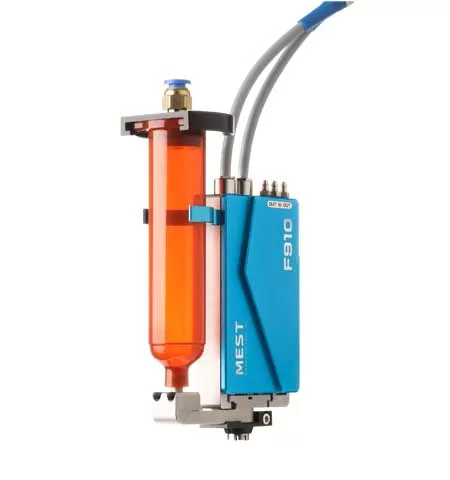
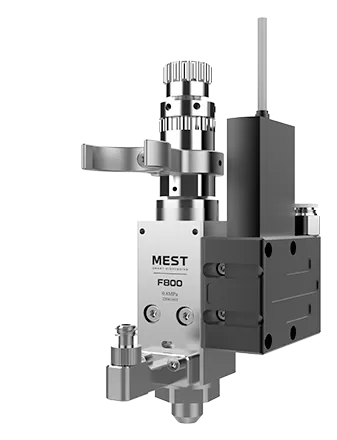
A piezo valve uses the deformation of a piezoelectric actuator to drive the dispensing mechanism. Because the actuator can respond extremely quickly and can be controlled precisely, a piezo jet valve is well suited to applications requiring small droplets, high dispensing frequencies, and consistent shot-to-shot performance.
A pneumatic jetting valve relies on compressed air to generate mechanical movement. The valve opens and closes through pneumatic actuation, making the system relatively straightforward to integrate into conventional automated dispensing equipment.
In practical production environments, piezo actuation is often selected when dispensing precision and throughput are the dominant requirements, whereas pneumatic systems remain attractive when equipment cost, system simplicity, or specific material characteristics carry greater weight.
Piezo actuation generally provides higher operating speed because the actuator has a very fast response and can perform rapid opening and closing cycles.
This matters when production lines require thousands or millions of individual deposits. Faster valve response reduces the time required between shots and allows the dispensing system to maintain a higher frequency without sacrificing control.
A pneumatic valve can also support high-speed dispensing, but its response is influenced by factors such as air pressure, tubing length, pneumatic circuit design, valve stroke, and mechanical inertia. These variables can become more significant as dispensing frequency increases.
For applications such as high-density PCB dispensing, semiconductor packaging, LED manufacturing, and fine adhesive deposition, the dynamic response of the valve becomes an important selection criterion rather than simply its nominal dispensing speed.
Material viscosity is one of the most important factors when comparing jetting technologies.
Both piezo and pneumatic systems can be engineered for different material ranges, but the actual jetting capability depends on more than viscosity alone. Material rheology, surface tension, particle loading, temperature sensitivity, curing behavior, and nozzle geometry can all affect whether a material can form a stable jet.
Higher-viscosity materials require sufficient mechanical force and optimized fluid-path design to generate consistent droplets. Pneumatic systems may be suitable for certain medium- to high-viscosity materials when sufficient pressure and valve configuration are available.
Piezo systems, meanwhile, can deliver highly controlled mechanical displacement, which is advantageous when precise energy transfer into the fluid is required. However, this does not mean every high-viscosity material is automatically better suited to a piezo valve.
For industrial selection, the material should be evaluated through actual jetting tests. A valve that performs well with low-viscosity adhesive may behave very differently with a filled, thixotropic, or rapidly curing compound.
A piezo jet valve generally has an advantage when the process requires highly repeatable micro-volume dispensing.
The piezo actuator allows precise control over actuation timing and displacement. This can help maintain consistent droplet volume when process parameters are properly optimized. The result is particularly valuable for applications where excessive material can cause defects or where insufficient material compromises bonding and electrical performance.
Pneumatic jetting accuracy is affected by pressure stability, air compression, mechanical response, and changes in dispensing conditions. With a well-designed system, pneumatic dispensing can still achieve reliable results, but maintaining extremely small and consistent deposits can become more demanding.
Accuracy should therefore be evaluated using actual process metrics such as droplet-volume variation, positional repeatability, minimum stable shot size, and consistency over extended production cycles.
It can, particularly in applications where the required deposit volume is very small.
Accurate control over dispensing time and actuator movement allows a piezo system to deliver repeatable micro-doses rather than relying on larger pressure pulses to achieve the required volume. Reduced over-dispensing can lower material consumption and minimize defects caused by excessive adhesive, coating, or encapsulant.
However, material savings depend on the complete dispensing process. Nozzle design, fluid pressure, material temperature, substrate characteristics, and control parameters all influence the final deposit.
For expensive materials such as conductive adhesives, underfills, UV adhesives, and specialized coatings, even a small reduction in average deposit volume can become significant across a high-volume production line.
A pneumatic system can have a lower initial equipment cost, particularly when the production line already has a reliable compressed-air infrastructure.
The total cost of ownership, however, should not be evaluated from valve purchase price alone. Maintenance, compressed-air consumption, material waste, production speed, calibration requirements, and rejected products can all affect long-term operating costs.
A piezo system may require a higher initial investment, but its higher precision and fast response can provide economic benefits in high-volume applications where cycle time and material utilization have a direct effect on production costs.
For lower-volume applications or processes with less demanding precision requirements, the simpler pneumatic approach may provide sufficient performance without the additional investment associated with advanced actuation technology.
Common pneumatic valve uses include adhesive dispensing, potting, sealing, coating, solder paste-related processes, and other automated applications where controlled material delivery is required.
Pneumatic technology is particularly practical when the material requires relatively substantial dispensing force or when the production system already uses compressed air for other automation functions.
The technology is also useful when dispensing requirements are moderate and ultra-fine droplet control is not the primary process objective. In these situations, a pneumatic valve can provide a balance between functionality, integration simplicity, and equipment cost.
A piezo jet valve becomes particularly valuable when several of the following requirements apply: high dispensing frequency, small deposit volume, strict repeatability, minimal material waste, and precise control of individual shots.
It is also worth considering when the dispensing process is expected to scale toward higher production volumes. Increasing line speed can expose limitations in pneumatic response, pressure stability, and shot consistency that may not be obvious at lower operating frequencies.
Typical applications include electronics assembly, semiconductor packaging, micro-adhesive dispensing, LED manufacturing, precision coating, and other processes where dispensing performance directly affects product quality.
Valve selection should begin with the material and required deposit rather than with the actuator technology.
Important parameters include material viscosity and rheology, target droplet volume, required dispensing frequency, acceptable volume variation, nozzle diameter, material temperature, particle content, curing characteristics, operating pressure, and substrate geometry.
Production requirements should also be considered. A valve intended for laboratory development may have very different priorities from one operating continuously on a high-volume automated line.
For demanding applications, manufacturers should compare valves using actual dispensing samples rather than relying only on nominal specifications. Droplet stability, satellite formation, repeatability, minimum reliable shot size, and performance after prolonged operation provide a much more meaningful basis for selection.
The comparison between a piezo jet valve and a pneumatic jetting valve is ultimately a question of process requirements.
Piezo technology generally offers advantages in speed, micro-volume control, and dispensing repeatability, making it suitable for high-precision and high-throughput manufacturing. Pneumatic technology remains practical where material requirements, dispensing volume, production speed, and budget allow a simpler actuation system.
The most reliable selection approach is to evaluate viscosity, required shot volume, operating frequency, accuracy, material waste, and total operating cost together. A properly matched valve can improve both dispensing quality and production efficiency far more effectively than selecting a technology based on purchase price alone.
Generally, yes. Piezo actuation offers very fast response and is well suited to high-frequency jetting applications.
Yes, depending on the valve design, nozzle, material rheology, and operating parameters. Actual material testing is recommended.
Pneumatic systems can provide a practical combination of dispensing force, system simplicity, and relatively low initial cost.
A piezo jet valve is generally better suited to highly repeatable micro-volume dispensing because of its precise actuator control.
Compare the material viscosity, target shot volume, dispensing frequency, accuracy requirements, waste tolerance, and total cost of ownership before selecting the valve technology.

Industry professional with deep expertise in dispensing manufacturing technology. Focused on precision fluid control, automation solutions, and process optimization for adhesive, sealant, and coating applications. Leverages practical knowledge of dispensing systems, fluid dynamics, and material science to analyze manufacturing challenges and contribute to efficient, reliable production processes. Experienced in collaborating with cross-functional teams to ensure clarity and precision in technical communication and implementation.